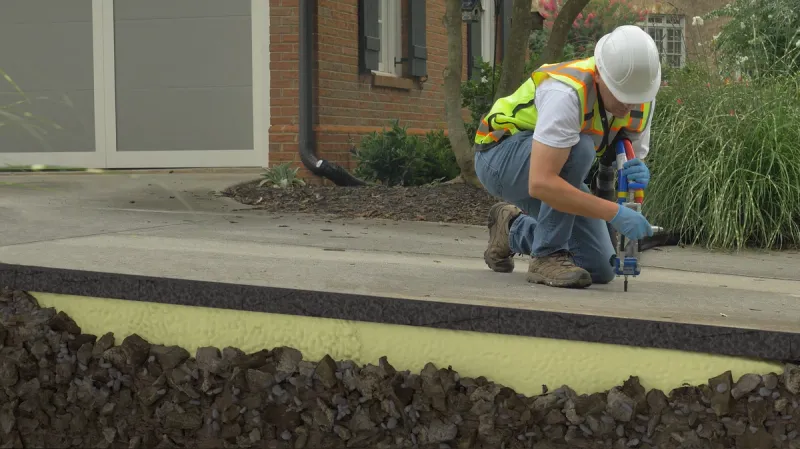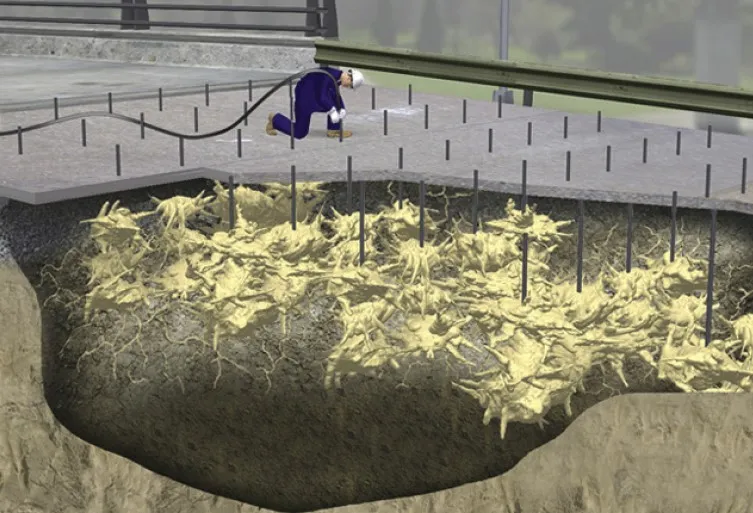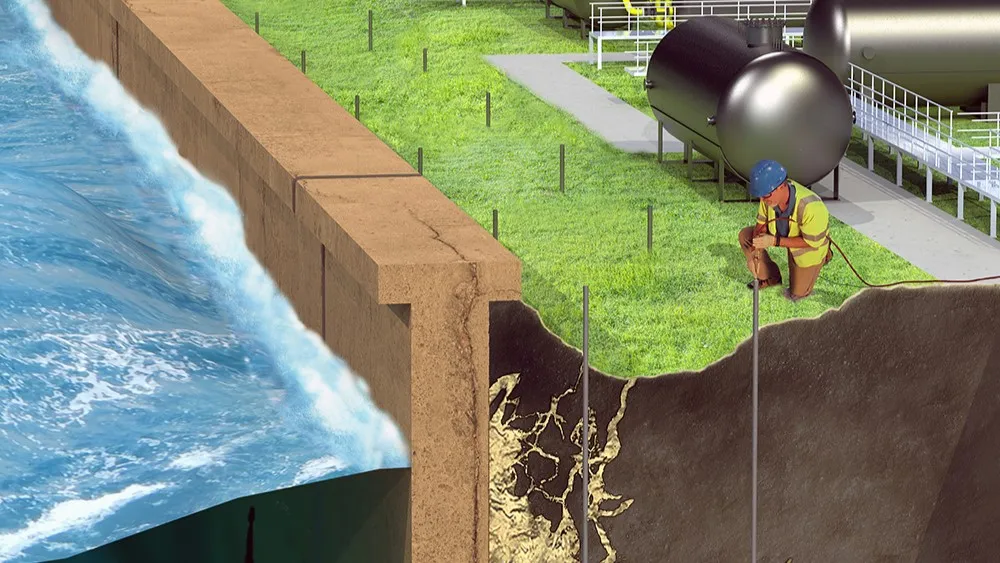
The Deep Lift® process can be described as improving soil bearing capacity several metres below buildings or other engineering structures. Unlike lifting settled floors, where the injections go directly under the floor, the Deep Lift® process solves soil density problems as deep as 10 metres. When lifting floors and foundations, the expansion force of the foam raises a specific structure, such as a building's foundations, to the required level. In the Deep Lift® process the injections are made in deeper layers, and their main purpose is to use the expansion force of the foam to compact deeper unstable soil layers, which can prevent the building or floors from settling again. The decision to use the Deep Lift® process is made after a geological survey and/or the results of a DCP (Dynamic Cone Penetration) test.
POWERFUL POLYMERS, CONVENIENT SOLUTIONS, FAST RESULTS
Poor soil compaction, soil erosion, broken utility
pipes and organic material in the soil can
cause soil and building foundations to settle.
Solving this kind of problem with traditional
methods is usually very labour-intensive and expensive. Repairing the damage often does not remove its
cause. Soil bearing capacity under a structure is often lost at a depth of two
or three metres,
and in some extreme cases even 10 metres.
Solving deep soil strengthening problems
requires no excavation
or exposing of foundations.
SPETEC® offers a unique
combination of high-quality polyurethane lifting foams
(AP DEEP LIFT 420, AP LIFT 430, AP LIFT
440, AP LIFT 475) that
are suitable for strengthening and lifting soil down to 10 m.
All
SPETEC® products are made in Belgium to ISO 14001:2015 and
ISO 9001:2015 standards.
These
materials are high-strength and environmentally safe,
and they are an extremely effective
solution to the problems described above.
Deep soil compaction brochure
Deep Lift®A clear example of how Spetec® AP LIFT series polyurethane foams help compact different soils:
Frequently asked questions
Why do building foundations and floors settle?
Erosion, poor drainage, badly placed underground utilities, damaged
water pipes and changing
groundwater levels. Poorly built bases and incorrectly compacted soil during construction or
renovation.
Biological decay. Construction waste, buried trees and other biodegradable
materials break down over time, and buildings or structures are often built on top of such
areas.
How do polymer foam products help?
• Settled structural elements are lifted back to the required
level with excellent
precision.
• Strengthening eroded and unstable soil layers: the polymer foam pushes out water
and hardens into a solid mass, stopping erosion.
• Soil compaction
AP LIFT foam injections
compact loose soil to create
a strong structure.
• Filling voids left by biological
decay
The polymer foam fills voids underground, and once it hardens the soil
regains the
density and strength it needs.
Why are these products environmentally safe?
AP LIFT series foams are safe in contact with drinking water
(NSF 61-5 certificate of
conformity). This means these products can
be used in any contact with drinking water. Our
products are thoroughly
tested, because environmental safety is the manufacturer's highest
priority.
Can the repaired area be used immediately?
SPETEC® AP Lift foams harden within 15 minutes.
How strong are the products and what load can they carry?
SPETEC® AP Lift foams can withstand loads of up to 69 tonnes/m²
depending on the product type
and application.
How to buy? What does it cost? Free samples:
Weekdays 8:00–17:00